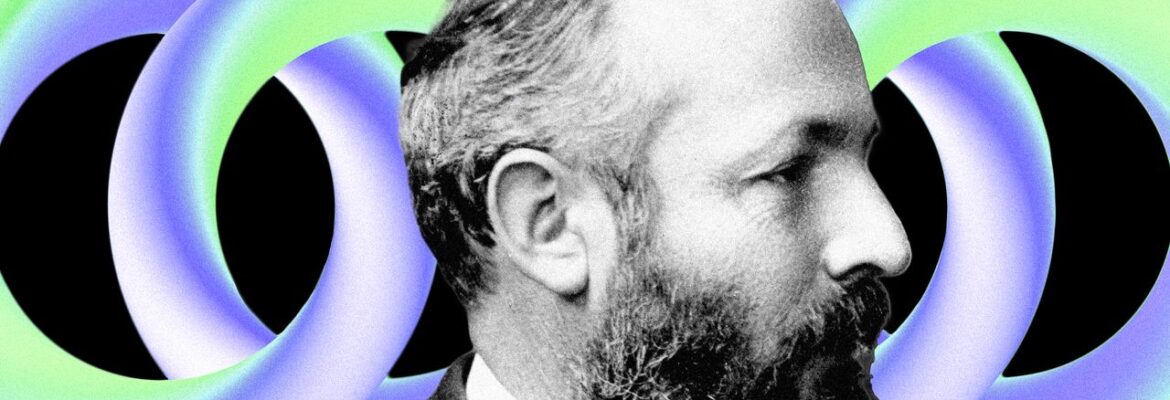
Mathematician who tried to convince the Catholic Church of two infinities
may have The laity were fugitives at the time, but for some observers the ascension of Leo XIV as head of the Catholic Church this year was a reminder that the last time Pope Leo sat in the chair of St. Peter at the Vatican, from 1878 to 1903, the modern view of infinity was born. Georg Cantor’s highly original “simple” set theory caused both a revolution and a riot in mathematical circles, with some accepting his ideas and others rejecting them.
Cantor was deeply disappointed by the backlash, of course, but never by his own ideas. why Because he believed he had a main line to the Absolute—from which his ideas flowed directly I have a divine intellect (Divine wisdom). And like the blues brothers Jake and Ellwood, he was on a mission from God. Thus, when he took the mathematical community by storm in 1883, he sought a new audience in the Catholic Church of Pope Leo XIII.
It was in Cantor’s later years that his mind became involved. He developed what I call Isaac Newton collection: a sickening, morbid aversion to publishing that comes with the paranoid certainty that your contemporaries are out to ruin you. They’re either a bunch of haters who don’t know about your work, or worse, jealous of your genius and selfishly belittling you for it. (Newton himself abandoned publishing for years due to criticism of his early work.)
Echoing Newton from two centuries earlier, Cantor wrote in 1887: “My inclinations do not prompt me to publish.” “And I will gladly leave this activity to others.”
For the next several years, Cantor increasingly focused on new audiences and tried to make inroads with the Catholic authorities. The 1880s is when the Catholic Church became more interested in scientific discovery than ever before. Leo XIII, who became Pope in 1878, has a special interest in science, especially cosmology. He claims that science is the way forward and has an astronomical observatory in the Vatican – one that he personally oversaw the construction of. He fills it with the best modern equipment and keeps professional astrologers on staff.
Cantor thinks the church has a lot to offer and set theory has a lot to offer. He wants the Catholic Church to be aware of his views because set theory is a way to understand the infinite nature of the divine—perhaps even the mind of God as reflected in mathematics. Is this not worth it? to consider
It’s a hard sell
Cantor shares his work with Cardinal Johannes Franzlin of the Vatican Council, one of the leading Jesuit theologians of his time. Franzlin wrote a letter to Cantor on Christmas Day 1885 and said that he was happy to receive Cantor’s works. “What makes me so happy,” he says, “is that it doesn’t seem like a hostile position, but actually a favorable position in relation to Christianity and Catholic principles.” Having said that, Cantor’s ideas are probably indefensible, Franzlin adds, and “in a sense, though the author seems not to have intended it, it contains the error of pantheism.”
