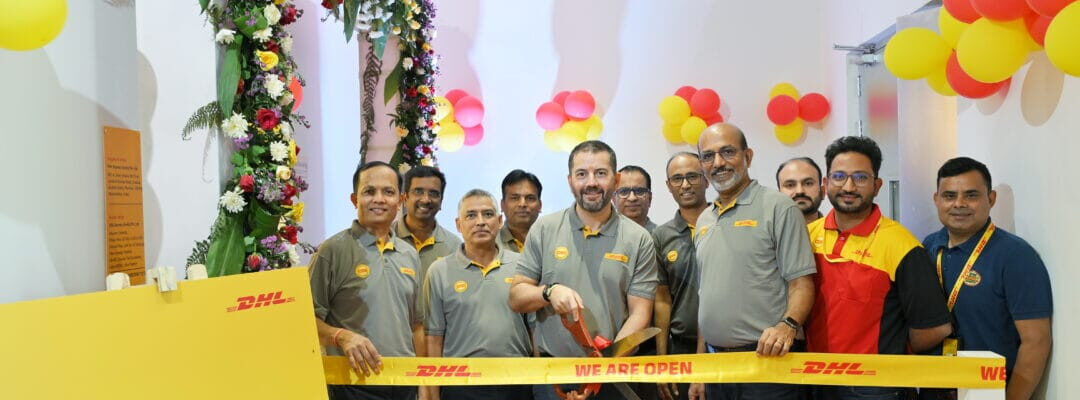
DHL expands the AGRA facility – air cargo week
DHL Express has announced the expansion of the service center and its transfer in AGRA. The new 3900 square feet facility provides significant automation and improve the ability to process goods that aim to reduce time to air and improve delivery performance. Development is expected to support the ecosystem for the decisive export of AGRA, especially small, small and medium enterprises (MSMES), with the intensification of global competition in time -shaping.
It is close to the main arterial roads linking AGRA with Delhi and the wider national capital region, and the upgraded facility includes a transmission system operating specially designed for commodity re -transmission engines (COY), as well as the separate infrastructure of non -financing materials (NXY). The design is designed to reduce bottlenecks in peak demand periods, while providing continuous efficiency on the expected capacity growth horizon until 2033.
Delivery of MSME exporters in Agra
AGRA is still a collection of export growth story that depends on MSME in India, produces leather goods, marble studs, shoes, handicrafts and textiles, among other things. The MSME sector represents approximately 49 % of India’s total exports in 2023-24, and in cities such as AGRA, these institutions rely heavily on reliable Express International networks to maintain time fulfillment obligations-especially via the electronic retail and retail sector in the United States, EU, and GULF Markets.
According to the Ministry of Trade, goods exports in India amounted to $ 437 billion in the fiscal year 2023-1024, as MSMES contributed about 214 billion dollars. Agra, although it is modest in the absolute value, carries a strategic weight in high -sideline categories such as hand -made shoes and decorative arts. DHL’s continuous investment in this sector is in line with both the national and local policy priorities aimed at increasing MSME exports by improving logistics and commercial facilitation.
“It has always been an integral part of the export story in India,” said DHL Express. “Our enhanced facility reflects our ten -year commitment to this vital market. The departure lines from AGRA now leaves 30 minutes, helping us to maintain the commitment of the Transit service by 98.1 % of DHL, while improving operating costs and providing long -term value to our customers.”
The alignment of expansion facility
It is expected to reduce automation features at the service center, including transportation systems and Reweight technology, from the time of goods processing by up to 20 %, translating into a measurable decrease at the time of the total charging cycle. This, in turn, improves synchronization with the air charging tables at the Delhi Gate in DHL, a major crossing point for international shipping arising from northern India. With dealing with Delhi International Airports, which exceeds 1.3 million tons of goods in 2024, the network alignment is essential to ensure that level cities 2 such as AGRA can reach global markets with consistency and efficiency.
“The AGRA Service Center offers immediately efficient and developed improvements to dealing with continuous size growth throughout the year until 2033. It is a ready-to-future knot in a critical geography,” added Peter Bardins, Senior Vice President-Asia and the Pacific Ocean, DHL Express, added.
The site, which is also promoted, includes an expanded expansion of cars and gradual vehicles for receipt and delivery cars (PUD), which is a major specified in the reliability of the first and last tunnel service in crowded urban environments. This structural design aims to increase the density of the road, reduce housing time, and provide sensitive and high value exporters while performing consistent goods.
National Trade Facilitation Policies
The DHL facility is compatible with the “India Government’s strategy to double exports by 2030” and complements initiatives under national logistical policy (NLP) and the PM GATI Shakti, both of which defend the use of modern logistical infrastructure to enhance India’s competitiveness.
DHL’s prominent policy symbolism with the General Directorate of Foreign Trade (DGFT), under which the company will start awareness, training and capacity -building programs for MSMes in AGRA in 2025. The cross -border e -commerce promotion system aims for cross -border requirements.
“Updating logistics services at the level of level 2 is necessary if India wants to open the full capabilities of the MSME export base,” said a senior DGFT official who talks about the background. “DHL facilities help reduce the cost of indirect logistics-13 % of GDP-by improving efficiency in the last situation and expanding access to international shipping corridors.”
The effects of the strategy
While the AGRA facility itself is relatively modest in size compared to other strategic investments in DHL – such as its two billion euros allocating to global life sciences and pharmaceutical centers – plays a major role in excessive central nodes and expanding the capabilities of rapidly explicit goods to immune manufacturing decorations.
In December 2024, DHL Express also expanded its service centers in Ludhiana and Chandigarh, combating more than 20,000 square feet of logistical capacity. The Ludhiana facility alone now deals with more than 3,500 charges per day-by 18 % on an annual basis-represented in the volume of demand in North India Industrial Industry.
Moreover, the upgrade AGRA is included in the “2030 DHL Strategy: accelerating sustainable growth”. While specific environmental standards have not been revealed for this site, DHL has committed to operating all new service centers with energy -saving systems, solar integration as this is possible, and adhere to the green construction rules that are compatible with the SBTI objective initiative (SBTI). These infrastructure transformations are extremely important, as fast logistical services are subject to increased scrutiny in their emissions 3, especially in air charging and delivery in the last tilt.
Logisti bridge
The DHL Express expansion is a symbol of the broader calibration in the rapid global logistics-which realizes the increasing importance of the ecosystems of the UNCA export, the policy-proof infrastructure, and the synchronization of the air freight network.
Since Indian MSMES faces increasing expectations about cost, speed and compliance in international trade, facilities such as the service center that was promoted from AGRA are no longer optional – they are essential. For the professionals of air freight policies, development provides an insight into how multinational integrated integrated in their global networks to comply with the goals of facilitating trade, sustainability mandates, and the flexibility of the supply chain from the next generation.
